
Our Olive Trees
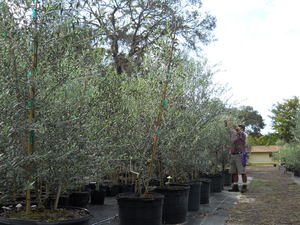
Our olive tree nursery
The owners of OTG have been involved in agriculture and horticulture for decades. Our commitment to excellence in our field is evident in the quality of our plants. We produce only the highest-quality trees and we possess the expertise to answer our customers' questions correctly and completely. We will be here for our customers after the sale. We cannot answer questions about trees from sources other than our nursery.
Whether olive culture is commercially viable in a particular area is a matter of scientific analysis and experimentation that takes years to determine. We are not in the business of advising would-be olive farmers or supplying trees for commercial grove development. According, we do not answer questions on the subject.
Olive Trees, Yesterday and Today
 In its native region, the Mediterranean Basin, the olive tree has held a special place in human culture for 8000 years. Ancient Greeks crowned the victors of Olympic games with wreaths of olive branches. The Romans used them in lustral rites. In the Hebrew and Christian religions, the olive branch has always symbolized peace and brotherhood. There are also many references to the olive in the Koran.
The olive is the most important oil-producing plant in the world. It is thought that the first agricultural machinery was developed to extract olive oil.
Olive wood, hard and tightly-grained, is prized for carving and furniture making.
The olive tree's beauty has motivated artists through the ages. Olive images are found on ancient Greek vases, Etruscan friezes, Impressionist paintings and modern textiles. Picasso's image of a dove with an olive branch is the international symbol of peace.
In the Mediterranean Basin, olives have traditionally been grown on the poorest soils, often on the fringes of agricultural viability. Premium lands were reserved for the more demanding fruits, vegetables and grains.
Because it originates in a region of little rainfall, many assume that the olive tree will not thrive in other regions. This assumption, though perhaps intuitive, is not supported by the facts. Old groves in Spain have been retrofitted with irrigation, resulting in a significant increase in yield. Olive culture has now been introduced into North and South America, Australia, New Zealand, China and India, as the world's cultures move to secure for themselves the benefits of the world's healthiest food oil.
Olives at Home
 For the gardening enthusiast, it is possible to have olive trees almost anywhere. London's Kew Botanical Garden has an olive tree that ripens a few fruit on occasion. In Paris, France, many hotels and restaurants have potted olive trees near the front entrance. Several people have reported having grown olive trees in New York City and Chicago, where they are wrapped and covered for winter protection or even buried horizontally in the ground for the winter, to be resurrected in the spring.
Olives can be grown in pots but growing a containerized tree is far different than growing a "house plant". Olive trees become large plants, 15' to 30' tall and equally wide. Keeping them contained but healthy in a pot requires advanced gardening techniques. Fruit production on olive trees grown in pots is very difficult and requires the highest level of gardening expertise.
There are over 800 cultivars (cultivated varieties) of olive developed over thousands of years in the Mediterranean Basin. Most of these remain local to their area of origin but some 150 cultivars have been dispersed to the major olive producing regions.